Totalization Agreement India US Social Security Explained

Content
Contents

Key Takeaways

  • India and the US do not have a Totalization Agreement as of 2026, exposing Indian professionals to double Social Security costs.
  • US payroll employees pay FICA at 7.65% (employee share), with employers matching another 7.65%.
  • US Social Security benefits generally require 40 credits (10 years), leading to large unutilized contributions for short-term Indian workers.
  • Self-employed US persons face Self-Employment Tax of 15.3%, and tax treaties do not override this without a Totalization Agreement.
  • Coverage Certificates, which prevent double contributions, are not available for India–US assignments.
  • India has concluded middle-ground agreements (e.g., Belgium) that differ materially from a full US-style totalization.

Introduction

For Indian Chartered Accountants building or scaling US tax practices, Social Security exposure is one of the most misunderstood cost drivers for cross-border clients. Many Indian professionals working in the US assume their contributions will eventually come back to them, or that tax treaties provide relief. In practice, neither assumption holds true for India–US cases.

This article equips Indian CAs with a practitioner-level understanding of the Totalization agreement India US social security issue—what it is, why it matters, and how its absence affects payroll, self-employment income, and long-term planning. We focus on how to advise clients correctly under current law, not on speculative policy outcomes.

You will learn the current negotiation status, the financial impact on Indian professionals, and practical compliance-first workarounds you can apply today. The goal is simple: help you price, plan, and position US tax services more accurately for your client base.

Why the Totalization Agreement Matters for India–US Workers

Avoidance of double social security payments by temporary workers

Totalization Agreements are designed to prevent employees on temporary overseas assignments from paying into two social security systems for the same work. Without such an agreement, workers can be compelled to contribute in both countries, even when benefits are not portable.

For India–US assignments, this means US payroll triggers FICA withholding while Indian systems like EPF may still apply depending on employment structuring.

Why Indian professionals are uniquely affected

Indian nationals represent one of the largest cohorts of temporary workers in the US, particularly on H-1B and L-1 visas. Industry estimates routinely place Indian nationals at 70%+ of H-1B approvals annually.

Practitioner Tip: Frame this issue early during onboarding. Social Security costs materially affect net compensation and can change optimal entity and payroll decisions.

What Is a Totalization Agreement?

Definition and purpose of a Totalization Agreement

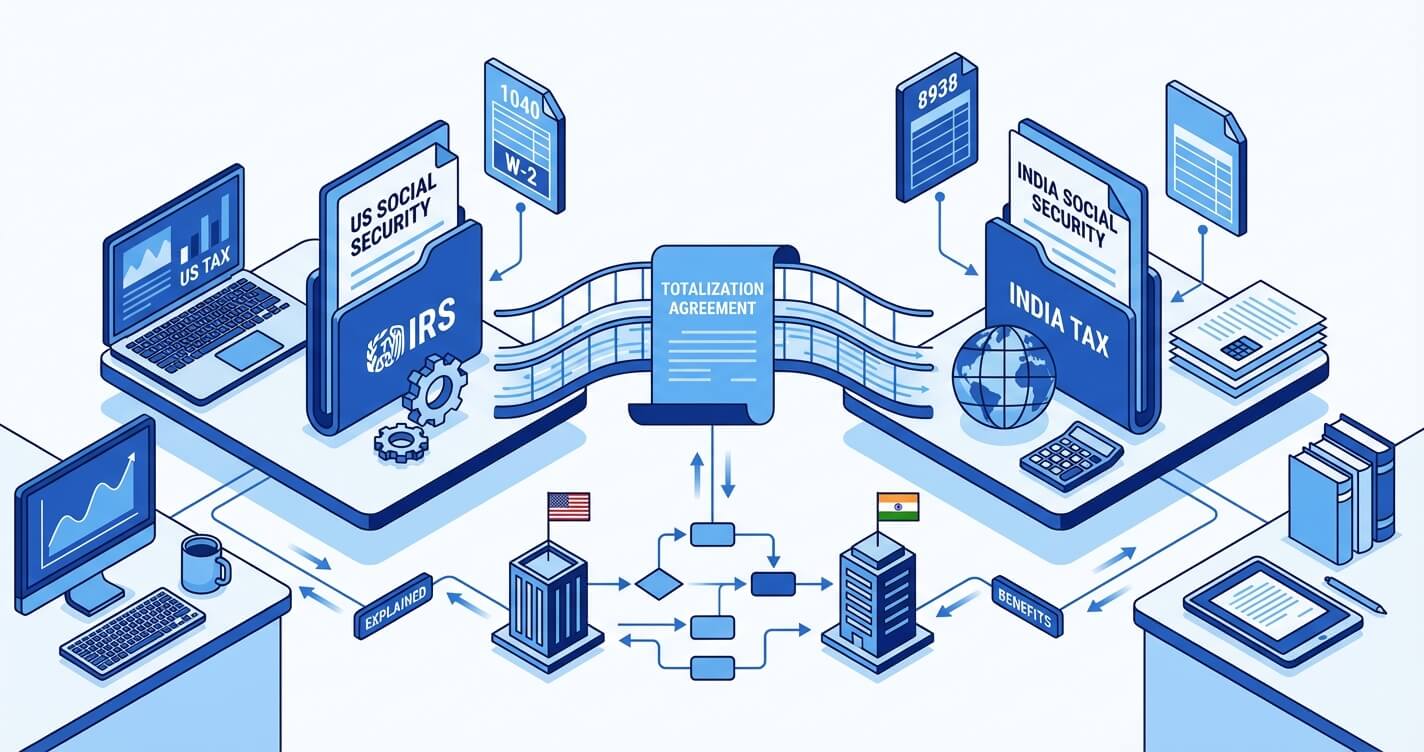
A Totalization Agreement is a bilateral treaty that coordinates social security coverage between two countries. Its primary purpose is to eliminate double social security taxation and allow benefit eligibility through contribution aggregation.

The US has such agreements with over 30 countries. The Social Security Administration provides an SSA overview of Totalization Agreements detailing their scope.

How Totalization Agreements work in practice

Typically, employees remain covered only under their home country’s system for a defined assignment period (often 5 years). Employers obtain a Coverage Certificate to exempt payroll from host-country social security.

Examples: US–UK and other existing agreements

Under the US–UK agreement, contributions in either country can be combined to meet eligibility thresholds, reducing benefit leakage. This model contrasts sharply with the India–US position.

Does the US–India Totalization Agreement Exist?

Current status of US–India negotiations

As of 2026, the US and India do not have a Totalization Agreement. Discussions have occurred intermittently under forums like the India–US Trade Policy Forum (TPF), but no binding outcome exists.

India’s position and demands

India has historically sought recognition of its Employees’ Provident Fund (EPF) system and portability of contributions. The US has raised concerns around transparency, withdrawal rules, and comparability.

Why the agreement has stalled

The US requires systems to be broadly comparable to Social Security in structure and data reporting. EPF’s lump-sum withdrawal features and coverage design have been sticking points.

Country PairAgreement TypeKey Feature
India–BelgiumLimited / Middle-groundDetached worker relief without full benefit totalization
US–UKFull TotalizationContribution aggregation and coverage certificates

Practitioner Tip: Do not assume India’s existing agreements set precedent for the US. Structuring advice must reflect US-specific standards.

Social Security Implications for NRIs and Indian Professionals in the US

FICA taxes for employees on US payroll

Employees on US payroll pay FICA comprising 6.2% Social Security (up to the annual wage base) and 1.45% Medicare. Employers match these amounts.

Indian EPF contributions and portability issues

US Social Security contributions generally do not count toward Indian retirement systems. Similarly, EPF balances are often inaccessible or tax-inefficient after extended non-residency.

What happens when workers leave before vesting

US Social Security benefits typically require 40 credits. Many Indian professionals return home within 3–6 years, resulting in zero benefit despite significant contributions.

Scale impact: With hundreds of thousands of Indian workers contributing annually, unutilized contributions likely run into billions of dollars over time.

Self-Employment Tax and Totalization: A Hidden Pain Point

How Self-Employment Tax works for US persons

Self-employed individuals pay 15.3% Self-Employment Tax covering both employer and employee portions of Social Security and Medicare.

NRIs, Indian consultants, and pass-through income

Indian-origin US residents, green card holders, and partners in US firms are exposed on Schedule C and partnership income.

Absence of relief without a Totalization Agreement

Tax treaties do not override Self-Employment Tax without a Totalization Agreement. The IRS clearly states this in its IRS guidance on Totalization Agreements and Self-Employment Tax.

Practitioner Tip: Always model Self-Employment Tax separately. Income tax optimization alone can be misleading.

Coverage Certificates and Why India–US Workers Don’t Have Them

What is a Coverage Certificate?

A Coverage Certificate confirms that an employee is covered under one country’s system and exempt from the other.

How it works under existing agreements

Employers present certificates to payroll providers to stop host-country withholding.

Consequences of not having one

India–US workers cannot obtain valid certificates, leading to mandatory FICA withholding and higher assignment costs.

Planning Workarounds and Practical Strategies (Until an Agreement Exists)

Employment structuring considerations

Careful analysis of employee vs independent contractor status is critical, but misclassification risks are high.

Entity-level and compensation planning

Timing bonuses, managing partnership allocations, and understanding payroll caps can marginally reduce exposure.

Advisory considerations for US tax preparers

Planning must remain compliance-first. Aggressive avoidance positions invite payroll audits and penalties.

Practitioner Tip: Integrate Social Security modeling with broader US tax work such as FIRPTA withholding on US real estate sales to present a holistic advisory narrative.

Conclusion

For Indian CAs advising US-connected clients, the absence of a Totalization Agreement between India and the US is not a policy footnote—it is a core planning constraint. Understanding FICA, Self-Employment Tax, and the limits of treaty relief allows you to set accurate expectations and avoid costly misadvice.

Until an agreement materializes, your role is to structure compliantly, quantify leakage, and integrate Social Security costs into broader US tax planning. This is where informed, practitioner-led guidance differentiates a mature US tax practice.

FAQ

Is there a Totalization Agreement between India and the US?

No. As of 2026, there is no Totalization Agreement in force. Contributions are not coordinated. Double exposure remains possible.

Can Indian professionals claim US Social Security refunds?

No direct refund mechanism exists. Benefits require 40 credits. Early departure usually means forfeiture.

Does the India–US tax treaty help with Social Security taxes?

No. Income tax treaties do not cover Social Security. Only Totalization Agreements provide relief.

Are H-1B workers exempt from FICA?

Generally no. FICA applies irrespective of visa category. Student exceptions are limited.

Does Self-Employment Tax apply to NRIs?

It applies to US persons, including residents and green card holders. Nonresidents may still face exposure depending on income characterization.

Can EPF contributions offset US Social Security?

No. Without an agreement, systems operate independently. No credit or offset exists.

What is the biggest planning mistake CAs make?

Ignoring Self-Employment Tax while focusing only on income tax. This understates true liability.

Are India’s other agreements relevant precedents?

Only partially. Belgium-style agreements are limited and not directly comparable to US requirements.

Should clients delay US assignments due to this issue?

That is a commercial decision. Advisors should quantify costs, not make immigration choices.

Will an agreement be signed soon?

There is no official timeline. Advising based on current law is essential.

Key Takeaways

  • India and the US do not have a Totalization Agreement as of 2026, exposing Indian professionals to double Social Security costs.
  • US payroll employees pay FICA at 7.65% (employee share), with employers matching another 7.65%.
  • US Social Security benefits generally require 40 credits (10 years), leading to large unutilized contributions for short-term Indian workers.
  • Self-employed US persons face Self-Employment Tax of 15.3%, and tax treaties do not override this without a Totalization Agreement.
  • Coverage Certificates, which prevent double contributions, are not available for India–US assignments.
  • India has concluded middle-ground agreements (e.g., Belgium) that differ materially from a full US-style totalization.

Introduction

For Indian Chartered Accountants building or scaling US tax practices, Social Security exposure is one of the most misunderstood cost drivers for cross-border clients. Many Indian professionals working in the US assume their contributions will eventually come back to them, or that tax treaties provide relief. In practice, neither assumption holds true for India–US cases.

This article equips Indian CAs with a practitioner-level understanding of the Totalization agreement India US social security issue—what it is, why it matters, and how its absence affects payroll, self-employment income, and long-term planning. We focus on how to advise clients correctly under current law, not on speculative policy outcomes.

You will learn the current negotiation status, the financial impact on Indian professionals, and practical compliance-first workarounds you can apply today. The goal is simple: help you price, plan, and position US tax services more accurately for your client base.

Why the Totalization Agreement Matters for India–US Workers

Avoidance of double social security payments by temporary workers

Totalization Agreements are designed to prevent employees on temporary overseas assignments from paying into two social security systems for the same work. Without such an agreement, workers can be compelled to contribute in both countries, even when benefits are not portable.

For India–US assignments, this means US payroll triggers FICA withholding while Indian systems like EPF may still apply depending on employment structuring.

Why Indian professionals are uniquely affected

Indian nationals represent one of the largest cohorts of temporary workers in the US, particularly on H-1B and L-1 visas. Industry estimates routinely place Indian nationals at 70%+ of H-1B approvals annually.

Practitioner Tip: Frame this issue early during onboarding. Social Security costs materially affect net compensation and can change optimal entity and payroll decisions.

What Is a Totalization Agreement?

Definition and purpose of a Totalization Agreement

A Totalization Agreement is a bilateral treaty that coordinates social security coverage between two countries. Its primary purpose is to eliminate double social security taxation and allow benefit eligibility through contribution aggregation.

The US has such agreements with over 30 countries. The Social Security Administration provides an SSA overview of Totalization Agreements detailing their scope.

How Totalization Agreements work in practice

Typically, employees remain covered only under their home country’s system for a defined assignment period (often 5 years). Employers obtain a Coverage Certificate to exempt payroll from host-country social security.

Examples: US–UK and other existing agreements

Under the US–UK agreement, contributions in either country can be combined to meet eligibility thresholds, reducing benefit leakage. This model contrasts sharply with the India–US position.

Does the US–India Totalization Agreement Exist?

Current status of US–India negotiations

As of 2026, the US and India do not have a Totalization Agreement. Discussions have occurred intermittently under forums like the India–US Trade Policy Forum (TPF), but no binding outcome exists.

India’s position and demands

India has historically sought recognition of its Employees’ Provident Fund (EPF) system and portability of contributions. The US has raised concerns around transparency, withdrawal rules, and comparability.

Why the agreement has stalled

The US requires systems to be broadly comparable to Social Security in structure and data reporting. EPF’s lump-sum withdrawal features and coverage design have been sticking points.

Country PairAgreement TypeKey Feature
India–BelgiumLimited / Middle-groundDetached worker relief without full benefit totalization
US–UKFull TotalizationContribution aggregation and coverage certificates

Practitioner Tip: Do not assume India’s existing agreements set precedent for the US. Structuring advice must reflect US-specific standards.

Social Security Implications for NRIs and Indian Professionals in the US

FICA taxes for employees on US payroll

Employees on US payroll pay FICA comprising 6.2% Social Security (up to the annual wage base) and 1.45% Medicare. Employers match these amounts.

Indian EPF contributions and portability issues

US Social Security contributions generally do not count toward Indian retirement systems. Similarly, EPF balances are often inaccessible or tax-inefficient after extended non-residency.

What happens when workers leave before vesting

US Social Security benefits typically require 40 credits. Many Indian professionals return home within 3–6 years, resulting in zero benefit despite significant contributions.

Scale impact: With hundreds of thousands of Indian workers contributing annually, unutilized contributions likely run into billions of dollars over time.

Self-Employment Tax and Totalization: A Hidden Pain Point

How Self-Employment Tax works for US persons

Self-employed individuals pay 15.3% Self-Employment Tax covering both employer and employee portions of Social Security and Medicare.

NRIs, Indian consultants, and pass-through income

Indian-origin US residents, green card holders, and partners in US firms are exposed on Schedule C and partnership income.

Absence of relief without a Totalization Agreement

Tax treaties do not override Self-Employment Tax without a Totalization Agreement. The IRS clearly states this in its IRS guidance on Totalization Agreements and Self-Employment Tax.

Practitioner Tip: Always model Self-Employment Tax separately. Income tax optimization alone can be misleading.

Coverage Certificates and Why India–US Workers Don’t Have Them

What is a Coverage Certificate?

A Coverage Certificate confirms that an employee is covered under one country’s system and exempt from the other.

How it works under existing agreements

Employers present certificates to payroll providers to stop host-country withholding.

Consequences of not having one

India–US workers cannot obtain valid certificates, leading to mandatory FICA withholding and higher assignment costs.

Planning Workarounds and Practical Strategies (Until an Agreement Exists)

Employment structuring considerations

Careful analysis of employee vs independent contractor status is critical, but misclassification risks are high.

Entity-level and compensation planning

Timing bonuses, managing partnership allocations, and understanding payroll caps can marginally reduce exposure.

Advisory considerations for US tax preparers

Planning must remain compliance-first. Aggressive avoidance positions invite payroll audits and penalties.

Practitioner Tip: Integrate Social Security modeling with broader US tax work such as FIRPTA withholding on US real estate sales to present a holistic advisory narrative.

Conclusion

For Indian CAs advising US-connected clients, the absence of a Totalization Agreement between India and the US is not a policy footnote—it is a core planning constraint. Understanding FICA, Self-Employment Tax, and the limits of treaty relief allows you to set accurate expectations and avoid costly misadvice.

Until an agreement materializes, your role is to structure compliantly, quantify leakage, and integrate Social Security costs into broader US tax planning. This is where informed, practitioner-led guidance differentiates a mature US tax practice.

FAQ

Is there a Totalization Agreement between India and the US?

No. As of 2026, there is no Totalization Agreement in force. Contributions are not coordinated. Double exposure remains possible.

Can Indian professionals claim US Social Security refunds?

No direct refund mechanism exists. Benefits require 40 credits. Early departure usually means forfeiture.

Does the India–US tax treaty help with Social Security taxes?

No. Income tax treaties do not cover Social Security. Only Totalization Agreements provide relief.

Are H-1B workers exempt from FICA?

Generally no. FICA applies irrespective of visa category. Student exceptions are limited.

Does Self-Employment Tax apply to NRIs?

It applies to US persons, including residents and green card holders. Nonresidents may still face exposure depending on income characterization.

Can EPF contributions offset US Social Security?

No. Without an agreement, systems operate independently. No credit or offset exists.

What is the biggest planning mistake CAs make?

Ignoring Self-Employment Tax while focusing only on income tax. This understates true liability.

Are India’s other agreements relevant precedents?

Only partially. Belgium-style agreements are limited and not directly comparable to US requirements.

Should clients delay US assignments due to this issue?

That is a commercial decision. Advisors should quantify costs, not make immigration choices.

Will an agreement be signed soon?

There is no official timeline. Advising based on current law is essential.
Latest from our blogs

Latest from our blogs

View All
]