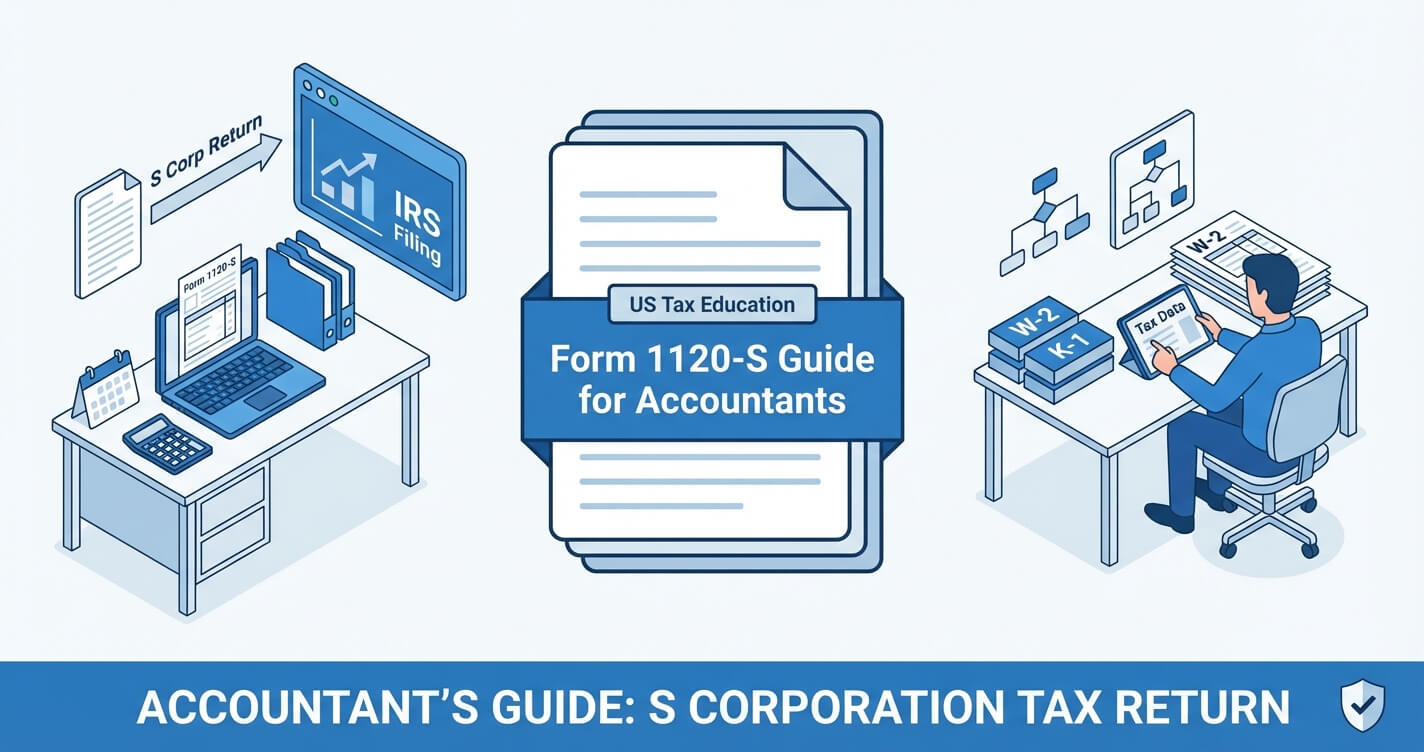
Form 1120-S S Corporation Tax Return Guide for CAs

Content
Contents

Key Takeaways

  • Form 1120-S is the annual federal return for S-Corporations, due by March 15 with a 6-month extension available via Form 7004.
  • S-Corps offer pass-through taxation but impose strict eligibility rules, including a 100-shareholder limit and a single class of stock.
  • Shareholder-employees must be paid reasonable compensation subject to payroll taxes; distributions are not a substitute for wages.
  • Schedule K-1 must be issued to shareholders by the filing deadline, with penalties starting at $310 per K-1 for late or incorrect filings.
  • Accurate tracking of shareholder basis, Schedule L, and M-1/M-2 reconciliations is critical to avoid IRS notices.
  • Many US states require separate S-Corp filings or elections, even when federal S status is accepted.

Introduction

For Indian Chartered Accountants building or scaling a US tax practice, S-Corporations represent one of the most common — and most scrutinized — entity types you will handle. Founder-led US businesses, professional services firms, and closely held companies frequently elect S-Corp status to optimize tax outcomes, but that choice shifts significant compliance responsibility onto the tax preparer.

This Form 1120-S S corporation tax return guide is written from a practitioner-to-practitioner perspective. It focuses not on taxpayer education, but on how you, as an Indian CA, should handle S-Corp filings for your US clients with accuracy, consistency, and audit defensibility.

You will learn how S-Corp elections work, how to prepare Form 1120-S step by step, how to manage Schedule K-1 reporting, and how to address high-risk areas like reasonable compensation and shareholder basis. The article also covers deadlines, penalties, state filings, and amended return procedures so you can deliver end-to-end S-Corp compliance with confidence.

What Is an S-Corporation?

Definition and tax treatment of an S-Corporation

An S-Corporation is a US domestic corporation that has elected to be taxed under Subchapter S of the Internal Revenue Code. From a tax perspective, it is a pass-through entity, meaning the corporation itself generally does not pay federal income tax.

Instead, income, deductions, credits, and losses flow through to shareholders and are reported on their individual tax returns via Schedule K-1. For practitioners, this means Form 1120-S is primarily an informational return.

How S-Corps differ from C-Corps and partnerships

Unlike C-Corporations, S-Corps avoid double taxation on profits. However, unlike partnerships, S-Corps impose strict eligibility rules and require shareholder-employees to be paid wages.

Operationally, S-Corps resemble C-Corps — with bylaws, officers, and formalities — but the tax outcome is closer to a partnership.

Why small businesses choose S-Corp status

Most clients elect S-Corp status to reduce self-employment taxes. Reasonable compensation is subject to payroll tax, while distributions are not.

Practitioner Tip: Always document the non-tax reasons for S-Corp elections (credibility, scalability, ownership clarity). This strengthens audit defensibility.

S-Corp Election and Its Tax Implications

Electing S-Corp status using Form 2553

S-Corp status is elected by filing Form 2553, signed by all shareholders. For new entities, the election must generally be made within 2 months and 15 days of formation.

Timing of election and late election relief

If Form 2553 is filed late, the IRS may grant late election relief if reasonable cause is established. As a preparer, you must ensure the relief statement aligns with IRS guidelines.

Ongoing compliance implications after election

Once elected, S-Corp status affects payroll processing, shareholder reporting, and state filings. Errors after election can terminate S status.

Practitioner Tip: When converting an LLC, confirm whether the client understands they are now subject to corporate payroll and Form 1120-S filing.

S-Corporation Eligibility Requirements

Shareholder and ownership restrictions

An S-Corp can have no more than 100 shareholders. Shareholders must generally be US citizens or resident individuals.

Eligible entities and classes of stock

Only one class of stock is permitted, meaning identical distribution and liquidation rights. Voting differences are allowed.

Disqualifying events and termination of S status

Issuing a second class of stock or admitting an ineligible shareholder can terminate S status immediately.

Practitioner Tip: Review operating agreements annually for changes that may violate S-Corp rules.

Overview of Form 1120-S

Purpose of Form 1120-S

Form 1120-S is the annual income tax return used by S-Corporations to report income, deductions, and shareholder allocations.

The IRS provides a detailed IRS overview of Form 1120-S outlining filing obligations.

Information required before you start

You will need trial balances, payroll records, shareholder ownership details, and prior-year basis schedules.

Filing deadlines and extensions

The standard deadline is March 15. A 6-month extension to September 15 can be obtained using Form 7004.

How to Prepare Form 1120-S: Step-by-Step

Lines A–J: S-Corporation information

This section captures entity details, business activity codes, accounting method, and S election status.

Part I: Income section explained

Report gross receipts, cost of goods sold, and other income. Ensure consistency with sales tax and payroll records.

Part II & III: Deductions and tax computation

Deductions include officer compensation, payroll taxes, rent, and professional fees. Review the IRS Instructions for Form 1120-S for line-level guidance.

Practitioner Tip: Misclassifying shareholder wages as distributions is one of the most common audit triggers.

Schedules K and K-1: Shareholder Reporting

What is Schedule K?

Schedule K summarizes the total income, deductions, and credits allocated to all shareholders.

Understanding Schedule K-1 for shareholders

Each shareholder receives a Schedule K-1 reflecting their pro-rata share. This flows into Form 1040.

Timeline and best practices for issuing K-1s

K-1s must be issued by March 15 or the extended due date. Late K-1s can trigger penalties of $310 per form.

Balance Sheet and Reconciliation Schedules

Schedule L: Balance sheet requirements

Schedule L is required if total receipts and assets exceed $250,000.

Schedule M-1: Book-to-tax reconciliation

This reconciles accounting income to taxable income.

Schedule M-2: Tracking retained earnings

Tracks accumulated adjustments account (AAA) and distributions.

Reasonable Compensation for S-Corp Shareholders

What is reasonable compensation?

Reasonable compensation is the wage a shareholder-employee would earn for similar services in the open market.

IRS scrutiny and audit risk

The IRS frequently reclassifies distributions as wages if compensation is understated.

Reasonable compensation benchmarks by industry

IndustryTypical Annual Range
IT Consulting$70,000–$120,000
Professional Services$80,000–$150,000
E-commerce$60,000–$100,000

Practitioner Tip: Retain third-party salary data and role descriptions in your workpapers.

Shareholder Basis and Distributions

What is shareholder basis?

Basis represents the shareholder’s investment and determines loss deductibility.

How basis affects distributions and losses

Distributions in excess of basis are taxable.

Common basis calculation errors

Ignoring loans or prior-year losses is a frequent issue.

Common Filing Errors and How to Avoid Them

Mistakes in reasonable compensation

Underpaying wages leads to payroll tax exposure.

Schedule K-1 mismatches

K-1 amounts must reconcile exactly with Schedule K.

Balance sheet and basis inconsistencies

Always reconcile Schedule L with books.

E-Filing, State Returns, and Amended Filings

E-filing vs paper filing requirements

E-filing is mandatory for preparers filing more than 10 returns.

State-level S-Corp filing considerations

Some states require separate S elections and impose franchise taxes.

Amended returns and corrections

Use Form 1120-X to amend errors within the statute of limitations.

How Tax Professionals Can Scale 1120-S Preparation

Challenges for small CA/CPA/EA firms

Volume spikes, review bottlenecks, and US payroll complexity limit growth.

Using automation and AI for compliance

AI-assisted workflows reduce reconciliation errors and turnaround time.

Maintaining accuracy at scale

Standardized checklists and automated diagnostics improve consistency.

Practitioner Note: Exploring AI-assisted Form 1120-S preparation can help you scale US compliance work without adding senior US tax staff.

Conclusion

Form 1120-S preparation sits at the intersection of entity compliance, payroll tax, and shareholder reporting. For Indian CAs, mastering S-Corp rules unlocks a large and recurring segment of US tax work.

By understanding elections, deadlines, reasonable compensation, and reconciliation schedules, you can deliver audit-ready S-Corp returns with confidence. The next step is building repeatable workflows that allow you to handle volume without sacrificing accuracy.

Many firms now augment their teams with AI-assisted review and preparation tools to support growth sustainably.

FAQs

When is Form 1120-S due for most S-Corporations?

Form 1120-S is due by March 15 for calendar-year S-Corps. An automatic six-month extension is available using Form 7004. The extension applies only to filing, not to shareholder tax payments. Late filing penalties apply per shareholder per month.

Can an Indian CA prepare Form 1120-S for US clients?

Yes, there is no restriction on who can prepare US tax returns. However, the preparer must understand US tax law and signing requirements. Many Indian CAs operate as outsourced preparers. Quality control and review processes are critical.

What triggers IRS audits for S-Corporations?

Common triggers include low or zero shareholder wages, inconsistent K-1s, and balance sheet mismatches. Repeated losses with distributions also attract scrutiny. Proper documentation reduces audit risk.

Is reasonable compensation mandatory every year?

Yes, if shareholders perform services for the S-Corp. Compensation must reflect current-year services. Skipping wages in low-income years is still risky.

How are losses handled in an S-Corp?

Losses pass through to shareholders but are limited to their basis. Excess losses are suspended. Tracking basis annually is essential.

Do all states follow federal S-Corp treatment?

No, some states tax S-Corps at the entity level. Others require separate elections. Always review state conformity rules.

What happens if an S-Corp issues a second class of stock?

This can immediately terminate S status. The entity may revert to C-Corp taxation. Corrective relief is limited and time-sensitive.

Can Form 1120-S be amended?

Yes, using Form 1120-X. Amended K-1s must also be issued. Amendments should clearly explain the changes.

Are K-1 penalties avoidable?

Penalties may be waived for reasonable cause. Timely extensions and proactive communication help. Chronic delays increase enforcement risk.

How can CA firms scale S-Corp compliance efficiently?

Standardized processes, checklists, and automation are key. AI-assisted preparation can reduce rework and review time. This allows firms to grow without proportional headcount increases.

Key Takeaways

  • Form 1120-S is the annual federal return for S-Corporations, due by March 15 with a 6-month extension available via Form 7004.
  • S-Corps offer pass-through taxation but impose strict eligibility rules, including a 100-shareholder limit and a single class of stock.
  • Shareholder-employees must be paid reasonable compensation subject to payroll taxes; distributions are not a substitute for wages.
  • Schedule K-1 must be issued to shareholders by the filing deadline, with penalties starting at $310 per K-1 for late or incorrect filings.
  • Accurate tracking of shareholder basis, Schedule L, and M-1/M-2 reconciliations is critical to avoid IRS notices.
  • Many US states require separate S-Corp filings or elections, even when federal S status is accepted.

Introduction

For Indian Chartered Accountants building or scaling a US tax practice, S-Corporations represent one of the most common — and most scrutinized — entity types you will handle. Founder-led US businesses, professional services firms, and closely held companies frequently elect S-Corp status to optimize tax outcomes, but that choice shifts significant compliance responsibility onto the tax preparer.

This Form 1120-S S corporation tax return guide is written from a practitioner-to-practitioner perspective. It focuses not on taxpayer education, but on how you, as an Indian CA, should handle S-Corp filings for your US clients with accuracy, consistency, and audit defensibility.

You will learn how S-Corp elections work, how to prepare Form 1120-S step by step, how to manage Schedule K-1 reporting, and how to address high-risk areas like reasonable compensation and shareholder basis. The article also covers deadlines, penalties, state filings, and amended return procedures so you can deliver end-to-end S-Corp compliance with confidence.

What Is an S-Corporation?

Definition and tax treatment of an S-Corporation

An S-Corporation is a US domestic corporation that has elected to be taxed under Subchapter S of the Internal Revenue Code. From a tax perspective, it is a pass-through entity, meaning the corporation itself generally does not pay federal income tax.

Instead, income, deductions, credits, and losses flow through to shareholders and are reported on their individual tax returns via Schedule K-1. For practitioners, this means Form 1120-S is primarily an informational return.

How S-Corps differ from C-Corps and partnerships

Unlike C-Corporations, S-Corps avoid double taxation on profits. However, unlike partnerships, S-Corps impose strict eligibility rules and require shareholder-employees to be paid wages.

Operationally, S-Corps resemble C-Corps — with bylaws, officers, and formalities — but the tax outcome is closer to a partnership.

Why small businesses choose S-Corp status

Most clients elect S-Corp status to reduce self-employment taxes. Reasonable compensation is subject to payroll tax, while distributions are not.

Practitioner Tip: Always document the non-tax reasons for S-Corp elections (credibility, scalability, ownership clarity). This strengthens audit defensibility.

S-Corp Election and Its Tax Implications

Electing S-Corp status using Form 2553

S-Corp status is elected by filing Form 2553, signed by all shareholders. For new entities, the election must generally be made within 2 months and 15 days of formation.

Timing of election and late election relief

If Form 2553 is filed late, the IRS may grant late election relief if reasonable cause is established. As a preparer, you must ensure the relief statement aligns with IRS guidelines.

Ongoing compliance implications after election

Once elected, S-Corp status affects payroll processing, shareholder reporting, and state filings. Errors after election can terminate S status.

Practitioner Tip: When converting an LLC, confirm whether the client understands they are now subject to corporate payroll and Form 1120-S filing.

S-Corporation Eligibility Requirements

Shareholder and ownership restrictions

An S-Corp can have no more than 100 shareholders. Shareholders must generally be US citizens or resident individuals.

Eligible entities and classes of stock

Only one class of stock is permitted, meaning identical distribution and liquidation rights. Voting differences are allowed.

Disqualifying events and termination of S status

Issuing a second class of stock or admitting an ineligible shareholder can terminate S status immediately.

Practitioner Tip: Review operating agreements annually for changes that may violate S-Corp rules.

Overview of Form 1120-S

Purpose of Form 1120-S

Form 1120-S is the annual income tax return used by S-Corporations to report income, deductions, and shareholder allocations.

The IRS provides a detailed IRS overview of Form 1120-S outlining filing obligations.

Information required before you start

You will need trial balances, payroll records, shareholder ownership details, and prior-year basis schedules.

Filing deadlines and extensions

The standard deadline is March 15. A 6-month extension to September 15 can be obtained using Form 7004.

How to Prepare Form 1120-S: Step-by-Step

Lines A–J: S-Corporation information

This section captures entity details, business activity codes, accounting method, and S election status.

Part I: Income section explained

Report gross receipts, cost of goods sold, and other income. Ensure consistency with sales tax and payroll records.

Part II & III: Deductions and tax computation

Deductions include officer compensation, payroll taxes, rent, and professional fees. Review the IRS Instructions for Form 1120-S for line-level guidance.

Practitioner Tip: Misclassifying shareholder wages as distributions is one of the most common audit triggers.

Schedules K and K-1: Shareholder Reporting

What is Schedule K?

Schedule K summarizes the total income, deductions, and credits allocated to all shareholders.

Understanding Schedule K-1 for shareholders

Each shareholder receives a Schedule K-1 reflecting their pro-rata share. This flows into Form 1040.

Timeline and best practices for issuing K-1s

K-1s must be issued by March 15 or the extended due date. Late K-1s can trigger penalties of $310 per form.

Balance Sheet and Reconciliation Schedules

Schedule L: Balance sheet requirements

Schedule L is required if total receipts and assets exceed $250,000.

Schedule M-1: Book-to-tax reconciliation

This reconciles accounting income to taxable income.

Schedule M-2: Tracking retained earnings

Tracks accumulated adjustments account (AAA) and distributions.

Reasonable Compensation for S-Corp Shareholders

What is reasonable compensation?

Reasonable compensation is the wage a shareholder-employee would earn for similar services in the open market.

IRS scrutiny and audit risk

The IRS frequently reclassifies distributions as wages if compensation is understated.

Reasonable compensation benchmarks by industry

IndustryTypical Annual Range
IT Consulting$70,000–$120,000
Professional Services$80,000–$150,000
E-commerce$60,000–$100,000

Practitioner Tip: Retain third-party salary data and role descriptions in your workpapers.

Shareholder Basis and Distributions

What is shareholder basis?

Basis represents the shareholder’s investment and determines loss deductibility.

How basis affects distributions and losses

Distributions in excess of basis are taxable.

Common basis calculation errors

Ignoring loans or prior-year losses is a frequent issue.

Common Filing Errors and How to Avoid Them

Mistakes in reasonable compensation

Underpaying wages leads to payroll tax exposure.

Schedule K-1 mismatches

K-1 amounts must reconcile exactly with Schedule K.

Balance sheet and basis inconsistencies

Always reconcile Schedule L with books.

E-Filing, State Returns, and Amended Filings

E-filing vs paper filing requirements

E-filing is mandatory for preparers filing more than 10 returns.

State-level S-Corp filing considerations

Some states require separate S elections and impose franchise taxes.

Amended returns and corrections

Use Form 1120-X to amend errors within the statute of limitations.

How Tax Professionals Can Scale 1120-S Preparation

Challenges for small CA/CPA/EA firms

Volume spikes, review bottlenecks, and US payroll complexity limit growth.

Using automation and AI for compliance

AI-assisted workflows reduce reconciliation errors and turnaround time.

Maintaining accuracy at scale

Standardized checklists and automated diagnostics improve consistency.

Practitioner Note: Exploring AI-assisted Form 1120-S preparation can help you scale US compliance work without adding senior US tax staff.

Conclusion

Form 1120-S preparation sits at the intersection of entity compliance, payroll tax, and shareholder reporting. For Indian CAs, mastering S-Corp rules unlocks a large and recurring segment of US tax work.

By understanding elections, deadlines, reasonable compensation, and reconciliation schedules, you can deliver audit-ready S-Corp returns with confidence. The next step is building repeatable workflows that allow you to handle volume without sacrificing accuracy.

Many firms now augment their teams with AI-assisted review and preparation tools to support growth sustainably.

FAQs

When is Form 1120-S due for most S-Corporations?

Form 1120-S is due by March 15 for calendar-year S-Corps. An automatic six-month extension is available using Form 7004. The extension applies only to filing, not to shareholder tax payments. Late filing penalties apply per shareholder per month.

Can an Indian CA prepare Form 1120-S for US clients?

Yes, there is no restriction on who can prepare US tax returns. However, the preparer must understand US tax law and signing requirements. Many Indian CAs operate as outsourced preparers. Quality control and review processes are critical.

What triggers IRS audits for S-Corporations?

Common triggers include low or zero shareholder wages, inconsistent K-1s, and balance sheet mismatches. Repeated losses with distributions also attract scrutiny. Proper documentation reduces audit risk.

Is reasonable compensation mandatory every year?

Yes, if shareholders perform services for the S-Corp. Compensation must reflect current-year services. Skipping wages in low-income years is still risky.

How are losses handled in an S-Corp?

Losses pass through to shareholders but are limited to their basis. Excess losses are suspended. Tracking basis annually is essential.

Do all states follow federal S-Corp treatment?

No, some states tax S-Corps at the entity level. Others require separate elections. Always review state conformity rules.

What happens if an S-Corp issues a second class of stock?

This can immediately terminate S status. The entity may revert to C-Corp taxation. Corrective relief is limited and time-sensitive.

Can Form 1120-S be amended?

Yes, using Form 1120-X. Amended K-1s must also be issued. Amendments should clearly explain the changes.

Are K-1 penalties avoidable?

Penalties may be waived for reasonable cause. Timely extensions and proactive communication help. Chronic delays increase enforcement risk.

How can CA firms scale S-Corp compliance efficiently?

Standardized processes, checklists, and automation are key. AI-assisted preparation can reduce rework and review time. This allows firms to grow without proportional headcount increases.
Latest from our blogs

Latest from our blogs

View All
]