Key Takeaways
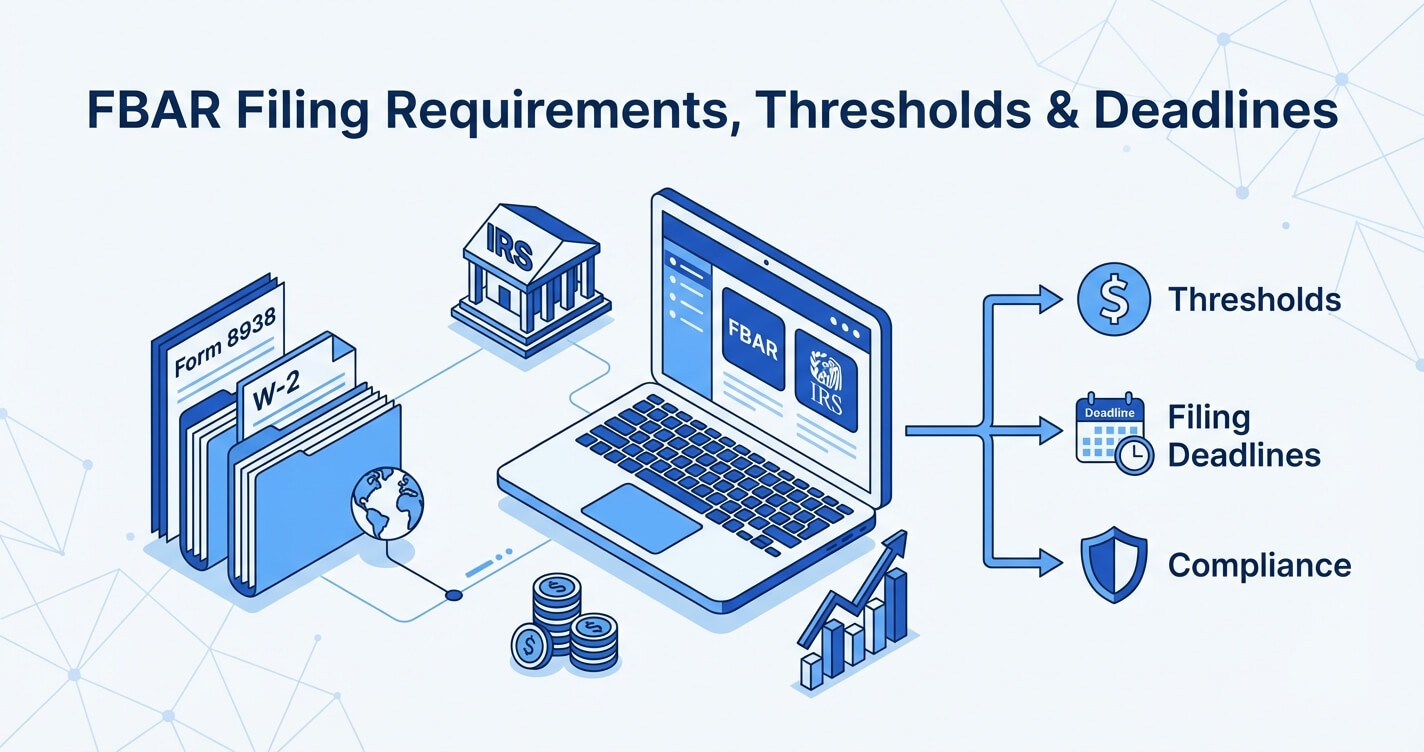
- FBAR (FinCEN Form 114) is required if the aggregate maximum balance exceeds $10,000 at any time during the calendar year.
- FBAR is filed with FinCEN through BSA E-Filing, not with the IRS and not with the income tax return.
- The standard FBAR deadline is April 15 with an automatic extension to October 15.
- Both financial interest and signature authority can independently trigger FBAR obligations.
- Indian savings, NRE, fixed deposits, demat, and mutual fund accounts are commonly reportable for U.S. persons.
- Non-willful penalties can reach $16,117 per violation, while willful penalties can be 50% of the account balance or $165,353, whichever is higher.
Introduction
As Indian Chartered Accountants expand into U.S. tax preparation, FBAR compliance quickly becomes one of the highest-risk areas you will manage for clients. Many U.S. persons with Indian financial footprints—bank accounts, NRE deposits, demat holdings, or legacy family accounts—trigger FBAR obligations even when no U.S. tax is payable.
This article is written for practitioners, not taxpayers. The objective is to help you identify when FBAR applies, calculate aggregate balances accurately, manage signature authority cases, and file FinCEN Form 114 correctly at scale. We focus on practical Indian-account examples and common errors seen during U.S. filing season.
You will learn how FBAR differs from income tax reporting, how the $10,000 threshold actually works, which Indian accounts are reportable, and how penalties escalate when filings are missed. The final sections address FBAR vs FATCA and operational considerations for firms handling multiple U.S. clients efficiently.
FBAR Explained: What It Is and Why It Matters
What Is FBAR (FinCEN Form 114)
FBAR stands for the Report of Foreign Bank and Financial Accounts, formally filed as FinCEN Form 114. It requires U.S. persons to disclose foreign financial accounts when thresholds are met.
How FBAR Fits Under the Bank Secrecy Act
FBAR is administered under the Bank Secrecy Act and is filed with the Financial Crimes Enforcement Network (FinCEN). The policy objective is to track offshore financial activity and deter tax evasion and money laundering.
Why FBAR Is Separate From Your Tax Return
FBAR is not filed with the IRS and does not form part of Form 1040 or 1120. It is submitted electronically through FinCEN’s BSA portal. Many clients incorrectly assume reporting interest income on Schedule B is sufficient.
Refer to IRS guidance on FBAR filing requirements when explaining this separation to clients.
Practitioner Tip: Always reconcile Schedule B disclosures with FBAR filings during review. Mismatches are a common audit trigger.
Who Must File FBAR: U.S. Persons, Interest, and Signature Authority
Who Qualifies as a U.S. Person
FBAR applies to U.S. citizens, resident aliens, green card holders, and certain domestic entities such as corporations, partnerships, and trusts.
Financial Interest in a Foreign Account
A financial interest exists when the U.S. person is the owner of record or has indirect ownership through entities. Indian family-held accounts frequently create indirect ownership exposure.
Signature Authority Explained
Signature authority exists when a person can control account disposition without owning it. Examples include a CFO with online banking access or an Indian CA authorized to operate a U.S. client’s Indian account.
Certain financial professionals with only signature authority may qualify for special filing relief, historically extending deadlines beyond the standard FBAR due date.
Practitioner Tip: Document whether authority is independent or joint. This determines both reporting scope and potential relief eligibility.
The $10,000 FBAR Threshold: What It Means in Practice
What Is the $10,000 Threshold
FBAR filing is required if the aggregate maximum balance of all foreign accounts exceeds $10,000 at any time during the year.
Aggregate Balance Rule Explained
The threshold applies to the combined highest balances of all foreign accounts. Even a single-day spike to $10,001 triggers filing.
Common Misunderstandings About the Threshold
The threshold is not per account. Dormant, zero-interest, or rarely used accounts are not excluded.
Practitioner Tip: Always request year-end and peak balance statements from each Indian bank to avoid underreporting.
How to Calculate Aggregate Balance: Indian Bank Account Examples
Step-by-Step Aggregate Balance Calculation
Identify each foreign account and determine the maximum balance during the year. Convert each maximum to USD and sum them.
Indian Savings, NRE, and Fixed Deposit Examples
Example: Indian savings account peak INR 3,50,000, NRE account peak INR 4,20,000, FD peak INR 3,00,000. Combined INR 10,70,000 converted to USD exceeds $10,000, triggering FBAR.
Currency Conversion Rules
Use the Treasury year-end exchange rate for conversion, not transaction-date rates.
Practitioner Tip: Clients with multiple Indian banks often miss legacy accounts. Use structured questionnaires to capture all relationships.
What Accounts Are Reportable on FBAR
Bank Accounts
Savings, checking, NRE, NRO, and fixed deposits held outside the U.S. are reportable.
Securities and Investment Accounts
Brokerage accounts, demat accounts, and foreign mutual funds must be reported. Indian mutual funds held through demat platforms are included.
Other Financial Accounts
Foreign pensions with cash value and insurance policies with investment components are reportable. U.S. military banking facilities are excluded.
FBAR Filing Deadlines and Extensions
Standard FBAR Due Date (April 15)
FBAR is due by April 15 following the calendar year.
Automatic Extension to October 15
An automatic extension applies until October 15. No request or Form 4868 is required.
Special Deadlines for Signature Authority Filers
Certain employees with only signature authority may qualify for extended relief under FinCEN notices.
Practitioner Tip: Track signature-only cases separately to ensure correct deadline application.
How to File FBAR Using the BSA E-Filing System
Overview of BSA E-Filing
FBARs are filed electronically through the BSA E-Filing System. Paper filing is not permitted.
Step-by-Step FinCEN 114 Walkthrough
Select FinCEN Form 114, enter filer details, account information, maximum balances, and ownership type. Review carefully before submission.
Common Filing Errors to Avoid
Incorrect maximum balances, missed joint owners, and wrong account types are frequent errors. Amendments can be filed if discovered later.
Practitioner Tip: Maintain standardized data capture sheets for Indian accounts to streamline multi-client filings.
FBAR Penalties and Compliance Risks
Non-Willful Violations
Non-willful penalties can reach $16,117 per violation, adjusted annually for inflation.
Willful Violations and Criminal Exposure
Willful penalties are the greater of $165,353 or 50% of the account balance. Criminal penalties may include fines and imprisonment.
Practitioner Tip: Late-discovered FBAR issues may qualify for Streamlined Filing Compliance Procedures if non-willful.
FBAR vs FATCA: Key Differences Every Preparer Must Know
FBAR vs Form 8938 Comparison
| Criteria | FBAR | Form 8938 |
|---|---|---|
| Filed With | FinCEN | IRS |
| Threshold | $10,000 aggregate | Higher FATCA thresholds |
| Applies to | Accounts | Specified assets |
Thresholds, Filing Authority, and Agencies
FBAR applies even when FATCA does not. FATCA details are covered in our Form 8938 FATCA reporting requirements guide.
US Territories and Reporting Differences
FBAR excludes accounts in certain U.S. territories, while FATCA treatment may differ.
Key Takeaways for Firms Handling FBAR Compliance at Scale
FBAR compliance hinges on accurate aggregation, correct account classification, and timely filing. For Indian firms, Indian bank and investment accounts are the primary risk area.
Standardized processes, clear client questionnaires, and systematic review reduce penalty exposure. As FBAR enforcement intensifies, scalable compliance frameworks become essential during peak filing season.
Conclusion
FBAR filing requirements, thresholds, and deadlines are non-negotiable elements of U.S. tax compliance. For Indian CAs, mastering these rules enables confident handling of U.S. clients with Indian financial ties.
Focus on aggregation accuracy, signature authority analysis, and disciplined filing workflows. Building these capabilities positions your firm to deliver compliant, scalable U.S. tax services without unnecessary risk.
FAQ
Do all U.S. clients with Indian bank accounts need FBAR?
No. FBAR is required only if the aggregate maximum balance exceeds $10,000 at any time during the year. Each case requires balance aggregation.
Is FBAR required if no income is earned?
Yes. FBAR is independent of income generation and applies based on balances alone.
Are NRE accounts reportable?
Yes. NRE accounts are foreign bank accounts and must be reported if thresholds are met.
How do we handle missed FBARs from prior years?
Non-willful cases may qualify for Streamlined Filing Compliance Procedures. Professional judgment is critical.
Does joint ownership change reporting?
No. Each U.S. person with ownership or authority must report the account.
Are Indian demat accounts reportable?
Yes. Demat accounts are considered securities accounts for FBAR purposes.
Is there any paper filing option?
No. FBAR must be filed electronically through BSA E-Filing.
Do signature-only employees always need to file?
Generally yes, though special relief may apply to certain professionals.
How does FBAR differ from FATCA reporting?
FBAR has lower thresholds and is filed with FinCEN, while FATCA is filed with the IRS.
What is the biggest FBAR risk for Indian CAs?
Incomplete account capture and incorrect aggregation across multiple Indian banks.